






























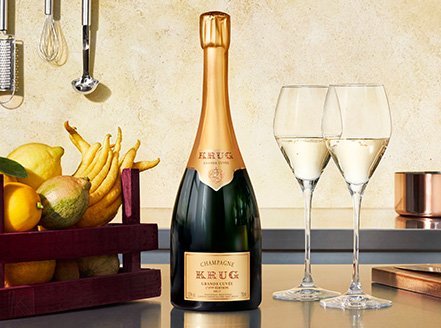
Introduction: A Glass Full of Invisible Forces
At first glance, Champagne looks simple.
A pale golden liquid. Rising streams of bubbles. A soft hiss as it is poured.
But beneath this elegance lies a highly complex system governed by physics and chemistry:
- Dissolved gas under pressure
- Surface tension and nucleation
- Aromatic compound release
- Fluid dynamics inside a glass
Champagne is not just a drink.
It is a controlled release of energy.
Every bubble you see is the visible result of invisible forces interacting at a microscopic level.
Chapter 1: Carbon Dioxide — The Hidden Engine
1.1 Where the Bubbles Come From
The bubbles in Champagne are made of carbon dioxide (CO₂), produced during secondary fermentation inside the bottle.
When yeast consumes sugar, it produces:
- Ethanol
- Carbon dioxide
Because the bottle is sealed, the gas cannot escape.
Instead, it dissolves into the liquid.
1.2 Pressure Inside the Bottle
A typical bottle of Champagne contains:
- Around 5–6 atmospheres of pressure
For comparison:
- This is about three times the pressure in a car tire
This pressure is what keeps CO₂ dissolved in the wine.
1.3 Supersaturation
Champagne is a supersaturated liquid:
- It contains more dissolved gas than it would under normal atmospheric conditions
When the bottle is opened:
- Pressure drops
- Gas begins to escape
This initiates bubble formation.
Chapter 2: Nucleation — Where Bubbles Are Born
2.1 Imperfections as Starting Points
Bubbles do not form randomly.
They begin at tiny imperfections called nucleation sites, such as:
- Microscopic scratches in the glass
- Dust particles
- Fibers
These sites trap small pockets of gas.
2.2 Bubble Formation Process
At a nucleation site:
- CO₂ diffuses into a tiny gas pocket
- The pocket grows
- A bubble forms and detaches
- The process repeats
This creates the familiar stream of bubbles rising in a Champagne glass.
2.3 Why Some Glasses Bubble More
Different glasses produce different bubble patterns due to:
- Surface texture
- Cleanliness
- Shape
Even microscopic differences affect visual behavior.
Chapter 3: Bubble Rise — Fluid Dynamics in Motion
3.1 Upward Movement
Once formed, bubbles rise due to buoyancy:
- Gas is less dense than liquid
- The bubble accelerates upward
3.2 Shape and Speed
As bubbles rise:
- They expand (pressure decreases with height)
- Their shape can deform slightly
- Their speed increases
3.3 Turbulence Effects
Rising bubbles create microcurrents:
- Stirring the liquid
- Distributing aroma compounds
- Enhancing sensory perception
Champagne is constantly in motion.
Chapter 4: Surface Interaction — The Moment of Release
4.1 Bubble Bursting
When a bubble reaches the surface:
- It forms a thin liquid film
- The film thins and breaks
- Gas is released into the air
4.2 Aerosol Formation
When bubbles burst, they create tiny droplets that:
- Carry aromatic compounds
- Disperse into the air above the glass
This is crucial for aroma perception.
4.3 Sound and Sensory Feedback
The subtle fizzing sound is produced by:
- Continuous bubble bursting
- Gas release events
Sound contributes to the perception of freshness.
Chapter 5: Temperature and Carbonation Stability
5.1 Why Champagne Is Served Cold
Lower temperatures:
- Increase CO₂ solubility
- Slow down gas release
- Preserve effervescence
Warm Champagne loses bubbles faster.

5.2 Temperature and Pressure Balance
As temperature rises:
- Gas solubility decreases
- Pressure inside liquid changes
- Bubble formation accelerates
Chapter 6: Foam and Texture
6.1 Foam Formation
When poured, Champagne creates foam due to:
- Rapid bubble formation
- Surface tension interactions
6.2 Stability of Foam
Foam stability depends on:
- Protein content
- Wine composition
- Bubble size
Fine bubbles create more stable foam.
6.3 Mouthfeel
Effervescence influences texture:
- Tingling sensation
- Perceived acidity
- Freshness
Champagne is experienced both chemically and physically.
Chapter 7: Bubble Size and Quality Perception
7.1 Fine vs Large Bubbles
Smaller bubbles are often associated with:
- Higher quality
- Better aging
- More controlled fermentation
7.2 Why Smaller Bubbles Matter
They:
- Rise more slowly
- Release aroma gradually
- Create smoother mouthfeel
7.3 Misconceptions
Bubble size is influenced by:
- Glass condition
- Serving method
Not just the Champagne itself.
Chapter 8: Aroma Release Mechanism
8.1 CO₂ as an Aroma Carrier
Carbon dioxide helps:
- Lift volatile compounds
- Transport aromas to the nose
8.2 Burst-Driven Aromatics
Each bursting bubble releases:
- Tiny jets of aroma-rich droplets
- Concentrated scent molecules
8.3 Dynamic Aromatic Profile
Unlike still wine:
- Champagne evolves continuously in the glass
- Aroma intensity changes over time
Chapter 9: Glass Shape and Physics
9.1 Flute vs Coupe
Different glass shapes affect:
- Bubble retention
- Aroma concentration
- Surface area
9.2 Narrow Glasses
- Preserve bubbles longer
- Concentrate streams
9.3 Wider Glasses
- Enhance aroma release
- Allow faster gas escape
The glass is part of the system.
Chapter 10: Time in the Glass
10.1 Degassing Over Time
After pouring:
- CO₂ gradually escapes
- Effervescence decreases
- Flavor profile shifts
10.2 Sensory Evolution
Early stage:
- Sharp, lively
Later stage:
- Softer, more aromatic
Conclusion: Champagne as Controlled Energy Release
Champagne is not static.
It is a dynamic physical system in constant transformation.
Inside every glass:
- Gas escapes
- Bubbles form and collapse
- Aromas rise and dissipate
- Texture evolves moment by moment
What we experience as elegance is actually the result of:
- Pressure
- Physics
- Molecular interaction
Champagne is, in essence:
A carefully engineered explosion—slowed down just enough for us to enjoy it.










