






























Introduction: Beyond Taste, Into Structure
When people describe red wine, they often use sensory language:
- Smooth
- Bold
- Dry
- Complex
But behind these impressions lies a dense network of chemical interactions.
Red wine is not just a mixture—it is a dynamic molecular system composed of:
- Water
- Ethanol
- Organic acids
- Phenolic compounds
- Aromatic molecules
These elements do not remain static. They evolve, interact, and transform over time.
Understanding red wine at the chemical level reveals something deeper:
Flavor is not a property—it is a process.
Chapter 1: The Base Matrix — Water and Ethanol
1.1 Water as Structural Medium
Red wine is approximately:
- 80–85% water
Water acts as:
- A solvent
- A carrier for dissolved compounds
- A stabilizing medium
1.2 Ethanol — More Than Alcohol
Ethanol typically makes up:
- 12–15% of red wine
Its roles include:
- Solvent for aromatic compounds
- Enhancer of volatility (helps aromas reach the nose)
- Contributor to body and warmth
1.3 Ethanol-Water Interaction
Ethanol changes how molecules behave in solution:
- Alters solubility of compounds
- Affects perception of aroma
- Modifies mouthfeel
This interaction is foundational to wine structure.
Chapter 2: Phenolic Compounds — The Backbone of Red Wine
2.1 What Are Phenolics?
Phenolic compounds are derived primarily from:
- Grape skins
- Seeds
- Stems
They include:
- Tannins
- Anthocyanins
- Flavonoids
2.2 Extraction During Fermentation
Phenolics are extracted through:
- Alcohol formation
- Heat
- Time in contact with skins
Winemakers control extraction to shape the wine’s structure.
Chapter 3: Tannins — Molecular Architecture of Texture
3.1 Chemical Nature of Tannins
Tannins are polyphenolic compounds that:
- Bind with proteins
- Form complex molecular chains
3.2 Astringency Mechanism
Tannins interact with saliva proteins:
- Precipitating them
- Reducing lubrication in the mouth
This creates the sensation of dryness.
3.3 Polymerization Over Time
As wine ages:
- Tannin molecules link together
- Become larger and less reactive
Result:
- Softer mouthfeel
- Reduced bitterness
Chapter 4: Anthocyanins — Color Chemistry
4.1 Source of Red Color
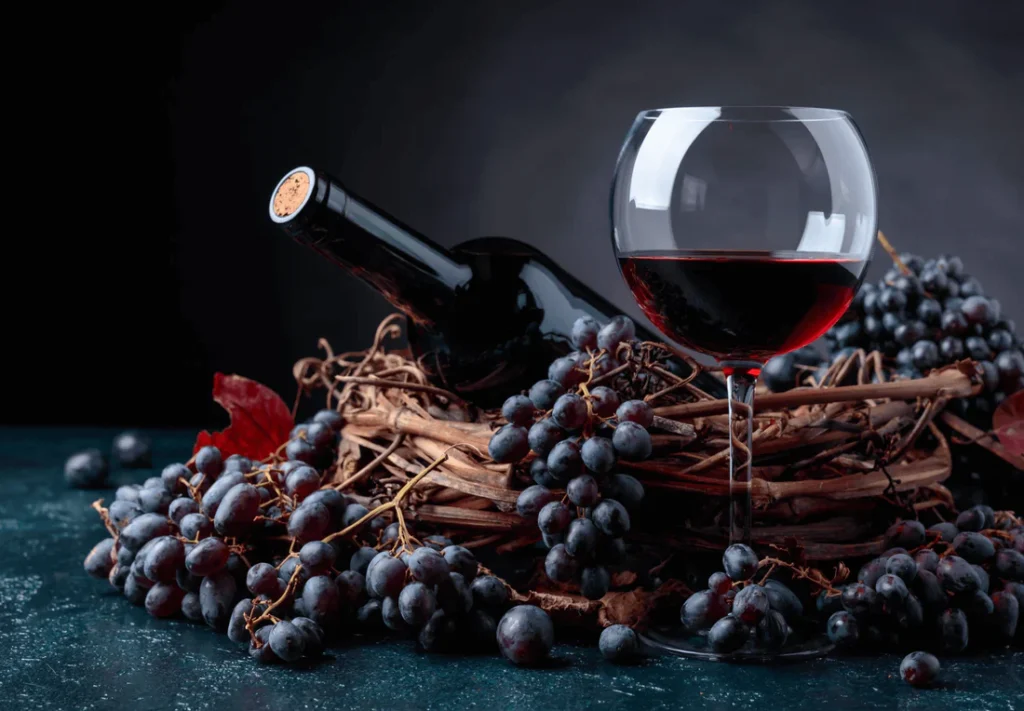
Anthocyanins are pigments in grape skins.
They are responsible for:
- Red
- Purple
- Blue hues
4.2 pH Sensitivity
Color changes depending on acidity:
- Lower pH → brighter red
- Higher pH → more purple/blue tones
4.3 Interaction with Tannins
Anthocyanins can bind with tannins:
- Stabilizing color
- Creating long-term pigmentation
This is why aged red wines shift in color over time.
Chapter 5: Acids — Structural Balance and Stability
5.1 Key Acids in Red Wine
Major acids include:
- Tartaric acid
- Malic acid
- Lactic acid
5.2 Role of Acidity
Acidity provides:
- Freshness
- Balance
- Microbial stability
5.3 Malolactic Fermentation
A secondary process converts:
- Malic acid → lactic acid
Effect:
- Softer acidity
- Creamier texture
Chapter 6: Aromatic Compounds — Volatility and Perception
6.1 Types of Aromatics
Aromatic compounds include:
- Esters → fruity notes
- Aldehydes → nutty, oxidized notes
- Terpenes → floral characteristics
6.2 Volatility and Release
Aroma perception depends on:
- Volatility (ability to evaporate)
- Temperature
- Ethanol concentration
6.3 Evolution Over Time
Aromas evolve from:
- Primary (fruit)
- Secondary (fermentation)
- Tertiary (aging)
Chapter 7: Oxygen — Controlled Chemical Influence
7.1 Micro-Oxidation
Small amounts of oxygen:
- Soften tannins
- Enhance complexity
7.2 Oxidation Risks
Too much oxygen causes:
- Loss of freshness
- Development of off-flavors
Balance is critical.
Chapter 8: Sulfur Compounds — Protection and Risk
8.1 Role of Sulfur Dioxide
Sulfur dioxide is used to:
- Prevent oxidation
- Control microbial activity
8.2 Aromatic Impact
At low levels:
- Protective
At high levels:
- Can affect aroma negatively
Chapter 9: Molecular Evolution During Aging
9.1 Chemical Reactions Over Time
Aging involves:
- Polymerization
- Oxidation
- Esterification
9.2 Flavor Transformation
Over time, wine develops:
- Less fruit intensity
- More complex, earthy notes
9.3 Stability vs Change
Wine exists in a balance between:
- Chemical stability
- Continuous transformation
Chapter 10: Perception — Where Chemistry Meets the Brain
10.1 Sensory Integration
Taste is influenced by:
- Smell
- Texture
- Temperature
10.2 Expectation Effects
Perception is shaped by:
- Context
- Label
- Prior experience
10.3 Complexity as Emergent Property
No single molecule defines flavor.
Complexity emerges from:
- Interactions between compounds
- Dynamic changes over time
Conclusion: Red Wine as a Living Chemical System
Red wine is not static.
It is a continuously evolving system where:
- Molecules interact
- Structures change
- Perceptions shift
Every sip is different from the last.
What we experience as “flavor” is actually the result of:
- Chemistry in motion
- Time unfolding
- Human perception interpreting it all
Red wine is not just made.
It continues to become.










