































Introduction: A Different Kind of Distillery
If you walk into a whiskey distillery, you hear rhythm—batch by batch, cycle by cycle. Heat rises, stills pause, decisions are made by hand.
But a grain spirit distillery feels different.
It does not feel like a sequence.
It feels like a flowing system that never stops.
There is no dramatic moment of transformation. No visible “beginning” or “end.”
Instead, there is:
- Continuous input
- Continuous separation
- Continuous output
It is not craftsmanship in the traditional sense.
It is industrial metabolism.
Section 1: The Raw Material Intake — Grain as Data Input
1.1 Arrival of Grain
Grain arrives not as character, but as quantity:
- Corn
- Wheat
- Rye
- Mixed cereal streams
The quality matters less in terms of flavor and more in terms of:
- Starch yield
- Fermentation efficiency
- Cost stability
1.2 Milling at Scale
Unlike small distilleries:
- Milling is automated
- Flow is constant
- Grain is processed like throughput material
The goal is uniform particle size for predictable conversion.
Section 2: Liquefaction and Fermentation — Controlled Biological Conversion
2.1 Enzyme-Driven Breakdown
Starch is converted into fermentable sugars using enzymes.
This process is engineered for:
- Maximum sugar extraction
- Minimal byproducts
- Consistent output
2.2 Industrial Fermentation Tanks
Fermentation happens in:
- Massive stainless steel vessels
- Temperature-controlled environments
- Highly monitored systems
Unlike whiskey fermentation:
- Speed is prioritized
- Flavor complexity is minimized
- Output consistency is critical
2.3 Yeast as a Production Tool
Yeast is selected for:
- Alcohol tolerance
- Efficiency
- Predictability
It is not chosen for aroma creation.
It is chosen for survival in high-alcohol environments.
Section 3: The Column Still — The Core Engine of Neutrality
3.1 From Batch to Continuous Distillation
The defining feature of grain spirits is the column still (continuous still).
Unlike pot stills:
- It runs continuously
- It separates compounds in real time
- It scales without interruption
3.2 Internal Structure of the Column
Inside the tall steel column:
- Multiple perforated plates
- Rising alcohol vapor
- Descending liquid reflux
Each stage refines purity further.
3.3 Rectification Process
Rectification is the repeated purification of alcohol vapor:
- Light compounds rise
- Heavy compounds fall
- Ethanol concentrates in the middle
This can reach up to ~96% ABV.
At this point:
- Flavor compounds are nearly eliminated
- Chemical neutrality is achieved
Section 4: Separation Science — Heads, Hearts, and Industrial Cuts
Even in continuous systems, separation logic exists.
4.1 Fraction Control
Operators control:
- Temperature gradients
- Reflux ratios
- Output purity levels
4.2 Removal of Congeners
Unwanted compounds include:
- Fusel alcohols
- Sulfur compounds
- Organic impurities
These are systematically reduced.
Section 5: The Output — Neutral Ethanol as Industrial Product
5.1 Final Composition
The final spirit is:
- ~95–96% ethanol
- Extremely low aromatic content
- Chemically stable
5.2 Not Yet a Beverage
At this stage, it is not meant for drinking directly in most contexts.
It becomes:
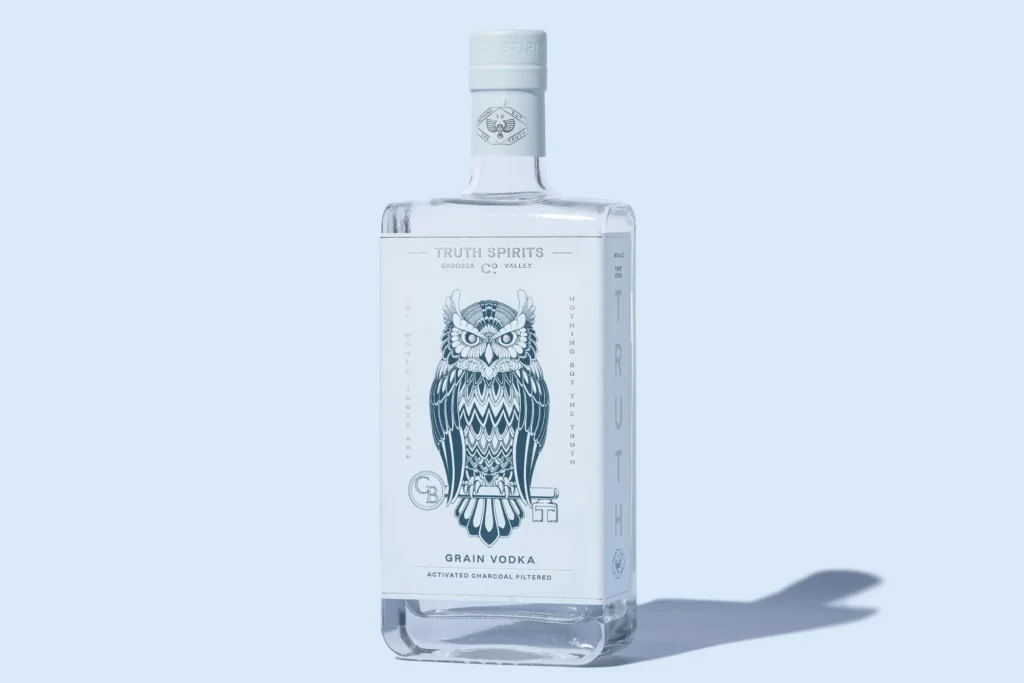
- A base for vodka
- A raw material for gin
- A solvent for flavor extraction
- An industrial input
Section 6: Energy, Scale, and Efficiency
6.1 Continuous Operation Advantage
Continuous distillation allows:
- Lower downtime
- Higher output volume
- Reduced labor per unit
6.2 Energy Optimization
Modern facilities focus on:
- Heat recycling systems
- Vapor recovery
- Process integration
Efficiency is a core design principle.
Section 7: Quality Control in a Neutral System
7.1 Paradox of Neutrality
Even “neutral” alcohol must be controlled for:
- Trace impurities
- Consistency across batches
- Regulatory compliance
7.2 Instrument-Based Monitoring
Instead of tasting, systems rely on:
- Gas chromatography
- Alcohol meters
- Real-time sensors
Human sensory input is minimal.
Section 8: From Spirit to Platform
8.1 Neutral Spirit as Infrastructure
Grain spirit is not an endpoint.
It is infrastructure for:
- Beverage industries
- Pharmaceutical use
- Flavor manufacturing
8.2 Industrial Flexibility
Because it has no strong identity:
- It can become anything
- It carries no fixed cultural meaning
Section 9: The Aesthetic of Industrial Alcohol
Unlike whiskey production:
- No aging warehouses
- No barrel romance
- No slow transformation visuals
Instead:
- Steel
- Flow
- Continuity
- Precision
It is industrial beauty rather than artisanal narrative.
Conclusion: A Spirit Designed to Disappear
Grain spirits produced in column stills represent a unique idea:
Alcohol not as character, but as capability.
They are designed to:
- Be consistent
- Be scalable
- Be adaptable
Where whiskey preserves time and rum preserves geography, grain spirits do something different:
They remove identity so that other identities can be built upon them.
They are not meant to be remembered.
They are meant to enable everything else.










